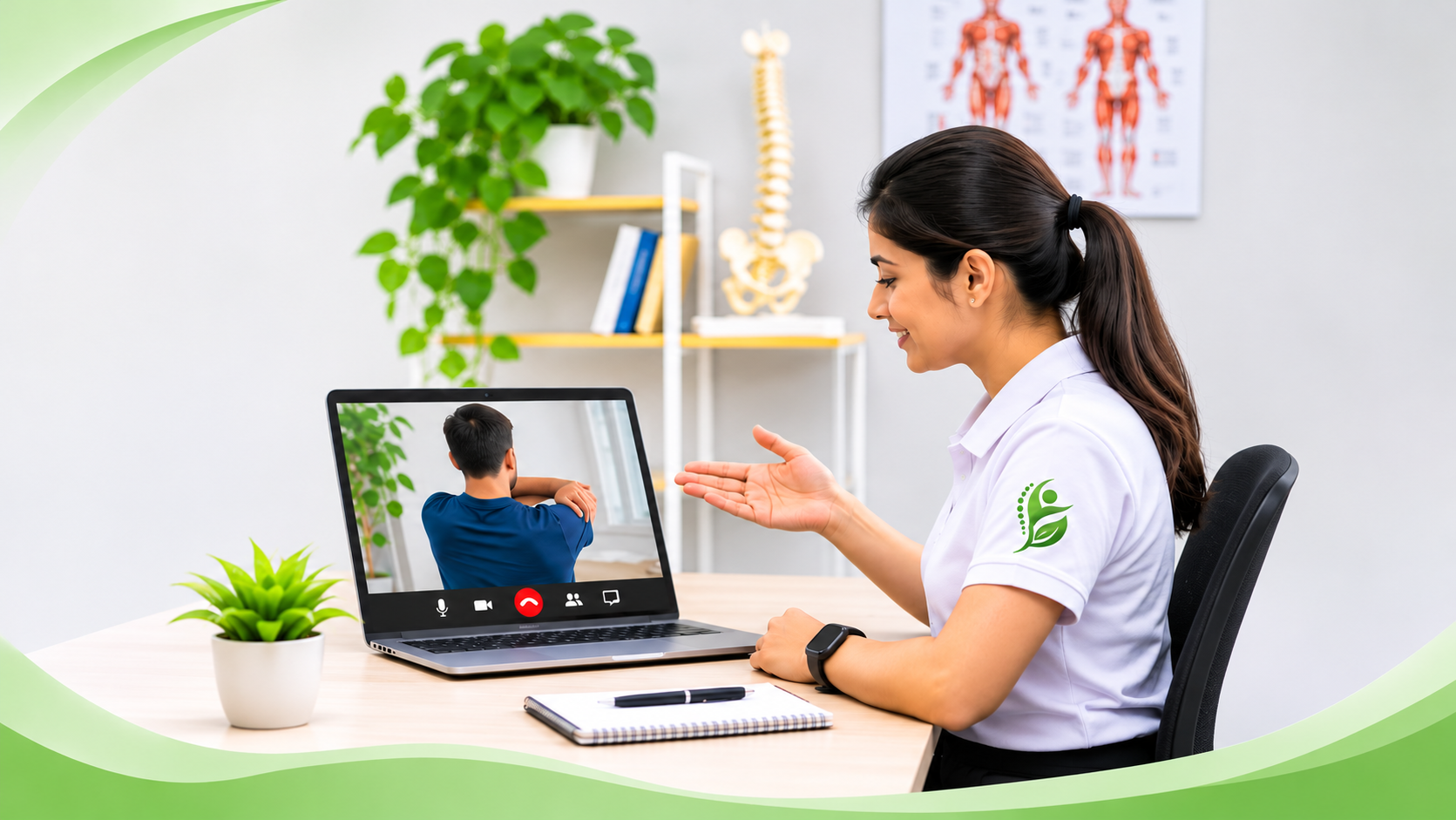
Access to quality healthcare has become increasingly vital in today's fast-paced world. However, geographical distance, busy work commitments, limited access to specialized clinics, and mobility constraints often prevent individuals from receiving consistent physical therapy.
Advancements in digital health have made it possible to deliver evidence-based care through secure video consultations. Known as online physiotherapy or telephysiotherapy, this approach empowers patients to consult qualified clinicians, undergo functional movement assessments, and follow tailored rehabilitation plans from home.
1. What Is Online Physiotherapy?
Online physiotherapy is a structured method of delivering clinical assessment, patient education, exercise prescription, and movement monitoring through digital communication platforms.
During a video session, your physiotherapist communicates directly with you to analyze symptoms, review medical history, observe movement patterns, and design a personalized recovery program.
Depending on your needs, a remote consultation typically encompasses:
- Video-based clinical assessments and symptom discussion.
- Postural and visual range of motion (ROM) analysis.
- Functional movement evaluation (e.g., squatting, bending, walking).
- Therapeutic exercise prescription and technique correction.
- Pain education and self-management strategies.
- Progress monitoring and ongoing program progression.
2. How Does Online Physiotherapy Work? (5-Step Process)
Step 1: Initial Consultation & Medical History
Your session begins with a comprehensive dialogue to understand your health concerns, pain location, aggravating factors, surgical history, and personal rehabilitation goals.
Step 2: Movement & Functional Assessment
Using clear camera angles, your physiotherapist evaluates physical parameters such as postural alignment, joint mobility, functional movement quality, and movement coordination.
| Assessment Parameter | Clinical Focus |
|---|---|
| Range of Motion | Evaluates joint flexibility and movement restrictions (e.g., shoulder or knee flexion). |
| Postural Observation | Observes head position, spinal alignment, and shoulder symmetry. |
| Functional Movement | Analyzes daily tasks like sit-to-stand transitions, squatting, and bending. |
| Exercise Technique | Verifies proper biomechanical execution during therapeutic movements. |
Step 3: Individualized Rehabilitation Plan
Based on assessment findings, a custom plan is designed—incorporating mobility work, targeted strengthening, postural retraining, and functional movement exercises tailored to your daily routine.
Step 4: Exercise Demonstration & Education
The clinician demonstrates each movement, explaining starting postures, execution speed, repetition counts, and common mistakes to avoid.
Step 5: Progress Monitoring & Follow-Up
Follow-up consultations assess improvements in joint mobility, pain reduction, and physical endurance, allowing your clinician to adjust exercise difficulty as you progress.
3. Core Benefits of Online Physiotherapy
- Improved Accessibility: Connects individuals living in remote areas with specialized clinical care without requiring travel.
- Convenience & Flexibility: Allows you to complete sessions comfortably at home or in your workplace around your busy schedule.
- Active Self-Management: Shifts focus toward patient education and active exercise therapy, empowering long-term physical independence.
- Continuity of Care: Frequent digital check-ins maintain exercise compliance and momentum throughout your rehabilitation journey.
4. Conditions That Benefit from Remote Care
Online rehabilitation is well-suited for a variety of conditions, including:
- Musculoskeletal Discomfort: Lower back tightness, neck strain, shoulder stiffness, and knee joint discomfort.
- Sports & Soft Tissue Injuries: Ankle sprains, muscle strains, tendon recovery, and return-to-sport conditioning.
- Postural & Desk Ergonomics: Work-related neck strain, upper back tightness, and poor postural habits.
- Sub-Acute Post-Operative Recovery: Guided exercise progression following orthopedic surgical procedures (once cleared by a physician).
5. Online vs. In-Person Physiotherapy
| Feature | Online Physiotherapy | In-Person Physiotherapy |
|---|---|---|
| Format | Remote Video Session | Clinic Visit |
| Movement & ROM Assessment | Visual & Camera-Based | Hands-On & Goniometric |
| Manual Therapy | Self-MWM & Guided Release | Direct Hands-On Mobilization |
| Exercise Guidance | Yes | Yes |
Ready to Restore Your Movement?
Book your assessment with PhysioCare, one of the trusted online physiotherapy platforms designed to bring expert clinical rehabilitation straight to your home.
Book Your Online Assessment